

 How do springs work in real-world applications? For manufacturers, the answer to that question is directly related to understanding the science of springs. In doing so, manufacturers such James Spring & Wire Company can accurately predict exactly how its extension, compression, or torsion springs will function within a mechanical device or mechanism even before the springs are turned on a coiling machine.
The design specifications of a spring is entirely dependent upon its application requirements. In other words, the application of an extension, compression, or torsion spring is determined by whether the spring function requires it to be pulled, pushed, or twisted for the application to work. The science of spring design however, relies on complicated algebraic formulas that give engineers precise and accurate results.
The design technology has advanced over time from the slide rule at the onset of the industrial revolution to the calculator and programmable calculator during the early and mid-Twentieth Century. In the latter half, with the advent of the computer, spring technology has benefited immensely and significantly increased the speed, efficiency, and predictability of spring design.
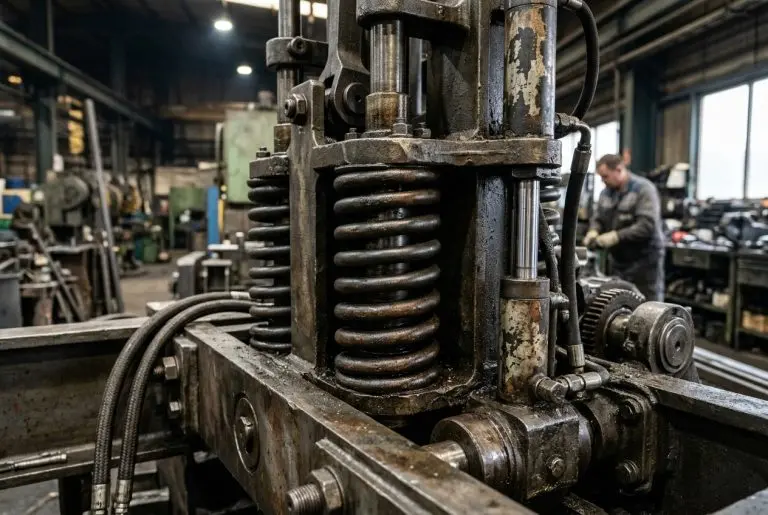
Today, springs serve as integral components in numerous applications large and small—machinery, engines, garage doors, medical instruments, tools, toys, aircraft, autos, and so much more. Yet, a spring is an elastic mechanical device or object that stores and releases energy when a force is applied to it. The elasticity allows the object to be deformed—stretched, squeezed, bent, twisted or compressed—only to return to its original shape once the energy from the deforming force is released.
Applications & Technology
Spring technology and its applications have evolved over countless centuries. Non-coiled spring technology dates from the dawn of civilization. Look no further than the bow and arrow, which has been in use around the world for tens of thousands of years or the spring suspension systems developed by the ancient Egyptians for their chariots. Though coiled springs date from the Bronze Age, It was not until the late Middle Ages when they became instrumental in the development of mechanical technologies such as clocks and portable watches, firearms, like cannons and pistols, and for transportation applications. Coaches and carriages adapted coiled and non-coiled springs to produce a smoother ride.
Hooke’s Law
The science of springs gained significant advancement with the publication in 1678 of British physicist Robert Hooke’s, Lectures de Potentia Restitutiva, Or of Spring: Explaining the Power of Springing Bodies. What became known as Hooke’s Law. Though varying types of springs had been in use for thousands of years, the elasticity and deformation of objects as a principal of physics was only first articulated by Hooke in writing on the linear relationship between the extension of a spring and its restoring force.
In applying Hooke’s Law, when a force is placed on an elastic object, that object stretches or compresses in response to the force. The deformation of an object is directly proportional to the deforming force or load. The object returns or, more aptly, ‘springs back,’ to the dimension it had before the load or stress was applied once the stress is removed. In the science of springs, Hooke’s Law is proportional to spring force and displacement. When violated the spring will fail. Meaning, if the elastic properties of the spring reach its limit, if the spring is extended too far, compressed too much, or twisted too tightly, it will remain permanently deformed and cease to conform to the law.
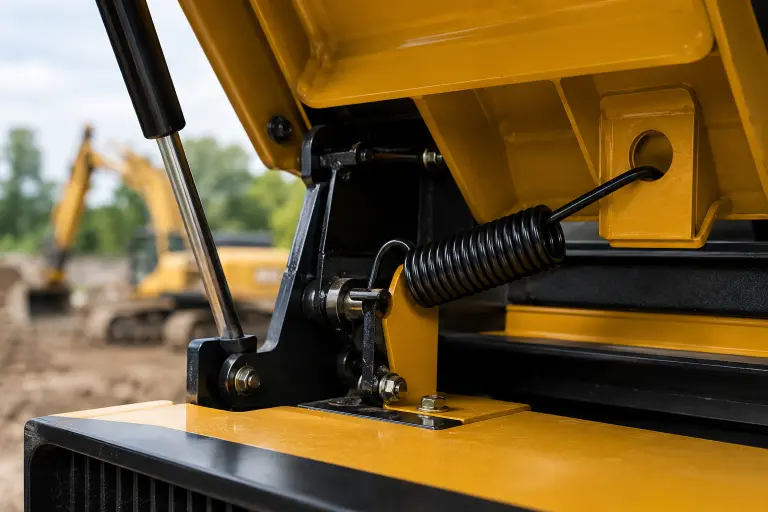
Hooke’s Law applied to the elastic limit of material which became of prime importance in the development of spring technology used in countless devices, machines and equipment. Today, the design and manufacture of springs rely on an in-depth understanding of the science of springs. They are widely used in the manufacture of parts and components for such industries as aerospace, automotive, construction, medical appliances and systems, electronics, agriculture, and many other general manufacturing sectors.
Common Spring Types
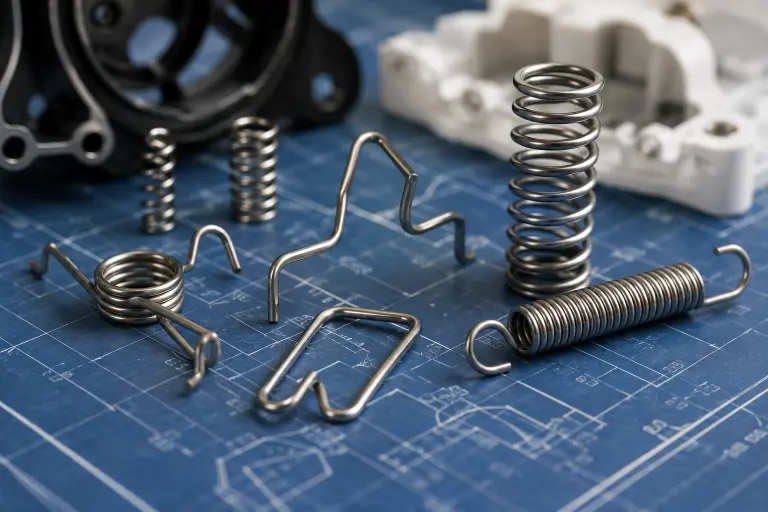
Though there are many varieties of springs designed by engineers for every conceivable application, the overwhelming majority of springs manufactured are the three with the most common industrial applications—the compression spring, extension spring, and torsion spring. Compression springs carry a load or, as the name implies, a compressive force that releases its mechanical energy when a force is applied to it, such as a car’s shock absorbers. An extension spring releases its mechanical energy through tension when a pulling force is applied, like the spring used to operate a garage door. Torsion springs derive their mechanical energy through twisting or torque forces when wound, such as that used to shut a screen door.
The science of springs has evolved substantially over the years with advances in technology. With its numerous designs, shapes and sizes combined with its inherent ability to store and release mechanical energy, the spring remains an indispensable mechanical component for countless applications.