Custom Torsion Springs that Hold the World Together
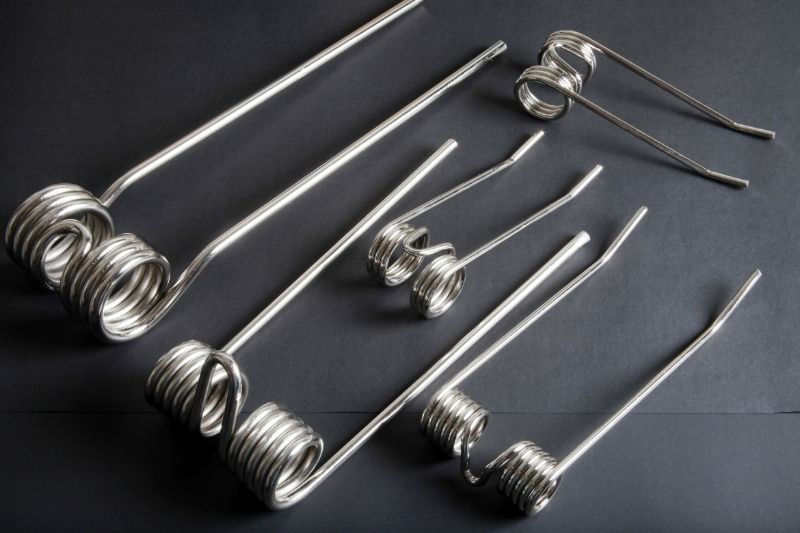
Torsion springs are helical springs designed to exert torque in a radial direction. Where compression springs push mechanisms apart, torsion springs hold them together — their tightness proportional to the energy stored inside. Tension must be released for the spring to give it back.
We carefully manufacture single-bodied and double-helical torsion springs in a range of end configurations, wound to rotate either clockwise or counter-clockwise. Operating environment, life expectancy, and spring load are all factored into the design of every part we make.
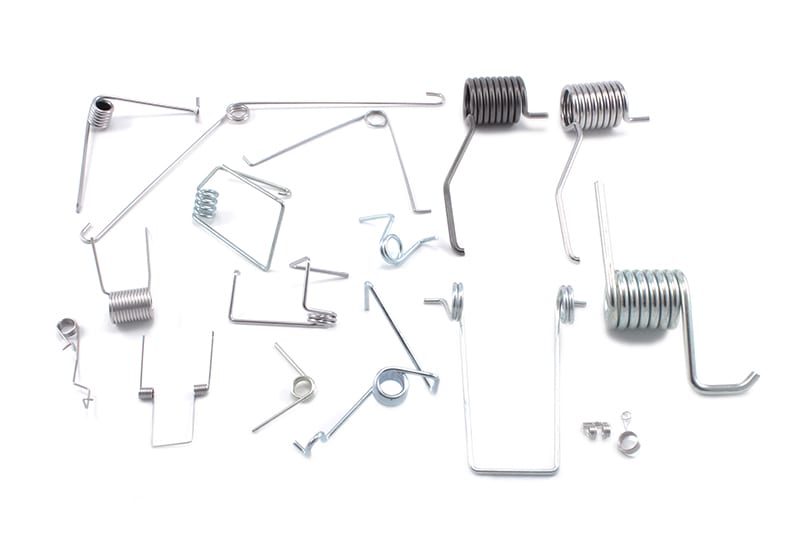
Choose from five standard leg/end styles — or specify a custom shape to match your assembly
01
Straight Ends
Tangent legs extending straight out from the coil body — the standard configuration.
02
Offset Ends
Legs bent to one side to clear adjacent parts or match an asymmetric mount.
03
Hinge Ends
Looped tips that accept a pin or pivot for hinged assemblies.
04
Short Hook Ends
Compact bent tips for assemblies where leg length must stay tight.
05
Custom Shaped Ends
Specialty geometries engineered to your specific attachment requirements.
Materials We Work With
The Right Material for Every Environment
We want to be your one-stop shop for any of your spring needs. Torsion springs can be manufactured from a wide range of materials, selected based on load, corrosion resistance, temperature, and product lifecycle expectations.
Music Wire
Oil Tempered
Chrome Vanadium
Phosphor Bronze
Inconel
Hastelloy
Elgiloy
Titanium
Hard Drawn Wire
Chrome Silicon
Stainless Steel (17-7, 302, 304, 316, 316L)
Beryllium Copper
Monel
MP35N
Nitinol
Engineering Support
Custom Torsion Spring Design
Our in-house engineering department designs torsion springs that account for operating environment, life expectancy, and spring load. Because a torsion spring is typically used over a shaft or arbor, we recommend allowing roughly 10% clearance on mandrel size for deflection — more if your application requires high deflection. Submit your design in any of the standard formats and we’ll respond with a manufacturable spec.
Our precision torsion springs return mechanisms to their seated position across countless applications — from hinges and latches to industrial actuators.
Torsion springs are used in a variety of applications, including automotive, aerospace, medical devices, and industrial equipment. They are designed to resist twisting or torque and are commonly used to provide rotational force or maintain tension in a system.
Torsion springs can be manufactured from a variety of materials, including stainless steel, carbon steel, alloy steel, and brass. The material used will depend on the specific application and the required performance characteristics of the spring.
There are several factors that should be considered when designing a torsion spring, including the spring’s intended use, the desired spring rate, the material used, the amount of torque required, and the available space for the spring.
The spring rate is the amount of torque required to rotate the spring by a certain angle. It is typically measured in pounds per inch (lbs/in) or newton-meters per degree (N-m/°).
The maximum torque a torsion spring can handle will depend on several factors, including the material used, the wire diameter, and the spring’s dimensions. It is important to carefully consider the maximum torque when designing a torsion spring to ensure that it will function properly and safely.
The manufacturing process typically involves coiling a wire around a mandrel, heat treating the spring to improve its strength and durability, and then forming the ends into legs or hooks to attach to the component or system. The legs or hooks are then rotated to generate torque. Learn more about the torsion spring manufacturing process.
Yes, custom springs can be manufactured to meet your specific requirements for torque capacity, spring rate, and other performance characteristics. Custom torsion springs are typically designed using computer-aided design (CAD) software and are manufactured using specialized equipment and techniques.
The lead time for manufacturing torsion springs will depend on the complexity of the spring, the quantity required, and other factors. Most torsion springs can be manufactured within 4-6 weeks.
Need a custom torsion spring? Let's talk specs.
Send us a drawing or a written spec — our engineers will respond with a manufacturable design and a quote, typically within two business days.