Custom Wire Forms
Four-Slide & CNC Wire Forming with In-House Tool & Die Making
Four-Slide, Multi-Slide & CNC
Wire, Manipulated into Whatever Shape Your Product Needs
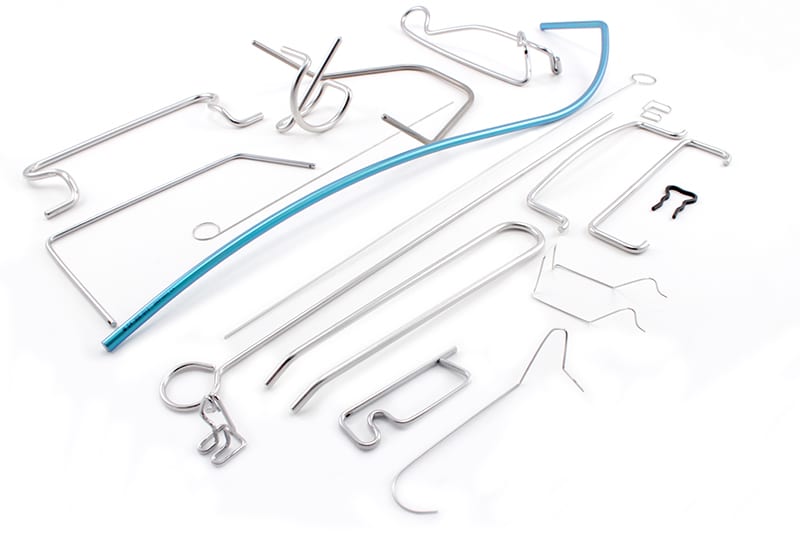
Wire forms are essentially wire bent into specific shapes, sizes, and configurations — often using sophisticated four-slide, multi-slide, and CNC precision machinery. Many spring and precision metal components are difficult or impossible to manufacture without these methods.
James Spring is one of the few diversified manufacturers that employs highly skilled tool and die makers to design and build specialized tooling and custom machines for our customers’ products. Our automatic equipment delivers precision accuracy and repeatability at any volume.
Wire Diameter
0.015″ – 0.250″
0.38mm – 6.35mm
Volumes
Prototype → Production
Handcrafted to high-volume runs
Equipment
Four-Slide & CNC Wire Formers
In-house tool & die making
Certification
ISO 9001:2015
PPAP · SPC
Common Wire Form Configurations
From simple bends to complex multi-axis profiles — specify your geometry and we'll build the tooling
01
Bends & Angles
Simple L, U, and angle bends formed to tight tolerances on four-slide tooling.
02
Loops & Hooks
Closed loops, partial hooks, and eyelet ends for fastening and pivoting.
03
Multi-Bend Forms
Complex zig-zag, wave, and serpentine geometries on multi-slide machines.
04
Closed Frames
Rectangular, oval, and irregular closed-perimeter forms with welded or formed joins.
05
Custom Profiles
Specialty geometries designed to your drawing — prototyped by hand before tooling.
Materials We Work With
The Right Material for Every Environment
We manufacture custom wire forms in a wide range of materials — from common ferrous wire to exotic alloys and non-ferrous metals like copper, brass, and bronze.
- Music Wire
- Oil Tempered
- Chrome Vanadium
- Phosphor Bronze
- Inconel
- Hastelloy
- Elgiloy
- Titanium
- Hard Drawn Wire
- Chrome Silicon
- Stainless Steel (17-7, 302, 304, 316, 316L)
- Beryllium Copper
- Monel
- MP35N
- Nitinol
Engineering Support
Custom Wire Form Design & Prototyping
Our in-house engineering department provides design assistance and verification — and our team can handcraft prototypes for your approval before we fabricate final tooling. Secondary operations cover small-batch work that isn’t suited to automatic formation, so we can support you from the first prototype through high-volume production.
Built for Products Across Every Sector
Industries Served
Our precision wire forms appear in everything from kitchen appliances to medical instruments and industrial assemblies.
Secondary & Finishing Services
Surface Treatment
- Anodizing
- Bead Blasting
- Citric & Nitric Passivation
- Cleaning – Conventional & Ultrasonic
- Color Coding
- Deburr – Vibratory & Tumble
- Electro Polish
- Laser Etching
- Powder Coating
- Rust Preventative
- Shot Peening
- Stress Relieving & Heat Treating
Plating
- Black Oxide
- Cadmium
- Chrome
- Gold
- Nickel
- Phosphate
- Tin
- Zinc
Quality Control
- Material & Part Certifications
- Production Part Approval Process (PPAP)
- Statistical Process Control (SPC)
- ISO 9001:2015 Registered
Frequently Asked Questions
Custom wire forms can be used in a wide variety of applications, from medical devices and electronics to automotive and industrial equipment. They are often used to provide structural support, electrical contacts, or mechanical linkages in a system.
Custom wire forms can be manufactured from a variety of materials, including stainless steel, carbon steel, aluminum, brass, and copper. The material used will depend on the specific application and the required performance characteristics of the wire form. Learn more about materials for spring design and wire forms.
There are several factors that should be considered when designing a custom wire form, including the form’s intended use, the desired strength and durability, the material used, and the available space for the wire form.
The manufacturing process typically involves bending, shaping, and cutting wire using specialized equipment, such as CNC wire bending machines. The wire is often subjected to various heat treatments and finishing processes to improve its strength, durability, and corrosion resistance. Learn more about wire form manufacturing.
Yes, they can be manufactured to meet your specific requirements for size, shape, strength, and other performance characteristics. Design assistance and verification of your designs are performed by our engineering department. We accept your designs in the following formats – .DWF, .DWG, DXF, FBX, JPG, PRT, SAT, TIF, STP, and PDF. Samples can be provided only to prove out tooling when tooling is listed on a formal quote. Feel free to inquire in detail about this process. Our in-house tool and die shop is ready to create tooling to allow us to produce most designed wire forms.

The lead time for manufacturing custom wire forms will depend on the complexity of the wire form, the quantity required, and other factors. Most wire forms can be manufactured within 4-6 weeks.
Yes, wire forms can be manufactured in large quantities using automated production processes using our CNC wire forming machines. This allows for high-volume production of wire forms while maintaining consistent quality and precision.
We use a variety of quality control measures to ensure that the wire forms meet the required specifications and performance standards. This includes visual inspections, dimensional measurements, and testing of mechanical properties, such as strength.
Need a custom wire form? Let's talk specs.
Send us a drawing or a written spec — our engineers will respond with a manufacturable design and a quote, typically within two business days.