
Consumer products are expected to perform reliably for years, often through thousands of cycles of use, changing environmental conditions, and repeated handling by end users. Whether it’s a door latch, window assembly, outdoor filtration system, appliance component, or recreational equipment, small mechanical components often play a critical role in product performance.
For OEM manufacturers, custom springs and wire forms are frequently among the most overlooked yet essential design elements. The right component can improve durability, user experience, and assembly efficiency, while the wrong design can contribute to premature wear, product failures, warranty claims, and increased production costs.
At James Spring & Wire, custom springs and wire forms are engineered to support the specific performance requirements of consumer OEM applications, helping manufacturers balance reliability, manufacturability, and cost throughout the product lifecycle.
Why Springs and Wire Forms Matter in Consumer Products
Consumer products often operate in environments that present unique design challenges. Components may be exposed to moisture, vibration, temperature fluctuations, repeated loading cycles, or frequent user interaction.
As a result, OEM designers must consider more than basic functionality when selecting spring and wire form components.
Important factors include:
- Cycle life requirements
- Environmental exposure
- Corrosion resistance
- Product safety considerations
- Space constraints
- Assembly efficiency
- Material selection
- Manufacturing scalability
The goal is not simply to make a component function—it is to ensure consistent performance throughout the life of the product.
Common Consumer Product Applications
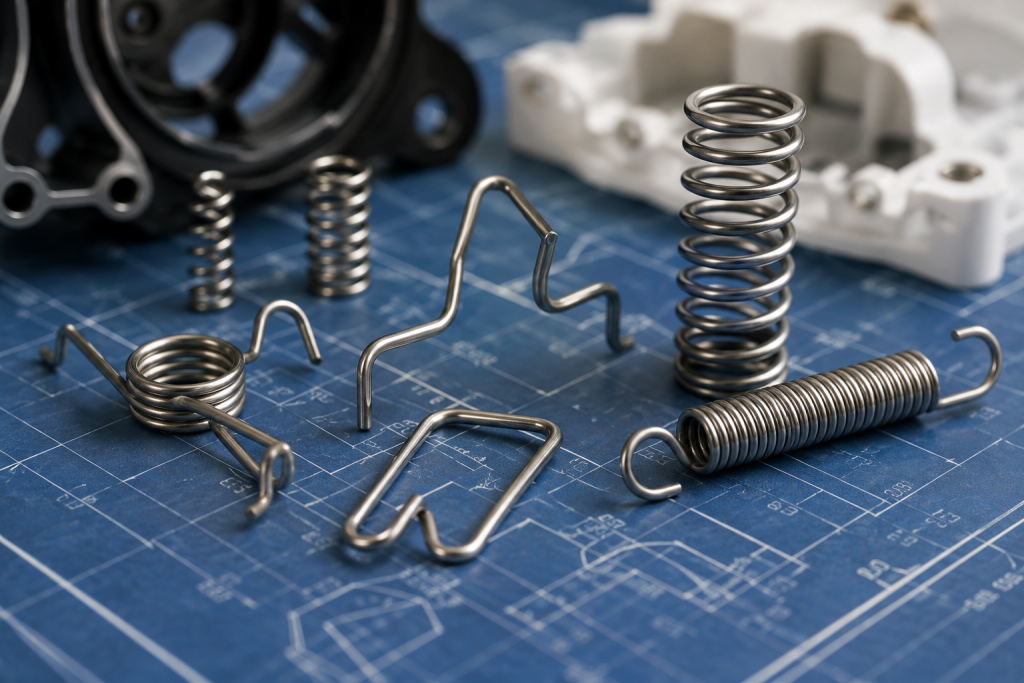
Custom springs and wire forms are found in a wide range of consumer goods, often performing critical functions behind the scenes.
Door Hardware and Locking Mechanisms
Door knobs, latches, locks, and handle assemblies frequently rely on springs to provide return force, maintain engagement, and ensure smooth operation.
Key considerations include:
- Consistent spring force
- Long-cycle durability
- Corrosion resistance
- Quiet operation
- Compact design requirements
Because these products may be used thousands of times annually, fatigue resistance becomes a critical design factor.
Window Assemblies
Window systems often incorporate springs and wire forms in balance mechanisms, latches, locking systems, and adjustment features.
OEM manufacturers must account for:
- Repeated cycling
- Variable loading conditions
- Exposure to humidity and temperature fluctuations
- Long-term dimensional stability
Proper spring design helps maintain smooth operation while reducing maintenance and replacement requirements.
Outdoor Filtration and Equipment Systems
Outdoor products frequently operate in demanding environments where moisture, dirt, UV exposure, and temperature extremes can accelerate component wear.
Common applications include:
- Filtration assemblies
- Lawn and garden equipment
- Outdoor recreational products
- Water treatment systems
Material selection becomes particularly important in these environments, with stainless steel and corrosion-resistant alloys often providing long-term performance advantages.
Appliance Assemblies
Appliances incorporate numerous springs and wire forms throughout their mechanical systems.
Applications may include:
- Door mechanisms
- Retention clips
- Control assemblies
- Safety features
- Internal support structures
For appliance OEMs, component consistency is critical to maintaining manufacturing quality and ensuring predictable product performance at scale.
Design Tradeoffs OEM Manufacturers Must Consider
Selecting the right spring or wire form often involves balancing competing priorities.
Performance vs. Cost
Higher-performance materials may increase component costs but can significantly improve durability and reduce warranty exposure.
OEM teams must evaluate:
- Product lifespan expectations
- Usage frequency
- Environmental conditions
- Serviceability requirements
The lowest-cost option is not always the most cost-effective solution over the product’s lifecycle.
Space Constraints vs. Load Requirements
Consumer products frequently require compact mechanical designs.
Design engineers often face challenges such as:
- Limited installation space
- Required force output
- Assembly constraints
- User experience considerations
Custom spring and wire form designs help optimize performance without compromising product packaging requirements.
Material Selection vs. Environmental Exposure
The operating environment should heavily influence material selection.
Factors may include:
- Humidity
- Corrosive conditions
- UV exposure
- Temperature variation
- Chemical exposure
Choosing materials based solely on initial cost can lead to premature failures in demanding environments.
Manufacturing Efficiency vs. Design Complexity
Complex geometries may improve product performance but can also impact production efficiency and scalability.
OEM manufacturers must evaluate:
- Assembly requirements
- Production volumes
- Tooling considerations
- Supply chain consistency
Early collaboration between design and manufacturing teams often results in more efficient and cost-effective solutions.
Supporting Consumer Product Innovation Through Custom Components
Consumer products continue to evolve as manufacturers pursue improved performance, durability, and user experience. Springs and wire forms remain critical components in achieving those objectives.
From door hardware and window systems to outdoor filtration equipment and appliance assemblies, custom-engineered components help manufacturers balance functionality, longevity, and production efficiency.
For OEM manufacturers, investing in properly designed springs and wire forms can contribute to more reliable products, improved customer satisfaction, and long-term manufacturing success.
Frequently Asked Questions
What types of consumer products use custom springs and wire forms?
Custom springs and wire forms are commonly used in consumer products such as door hardware, window assemblies, appliances, outdoor equipment, filtration systems, recreational products, and various mechanical assemblies. These components provide force, retention, positioning, support, and motion control functions that contribute to product reliability and performance.
Why do OEM manufacturers choose custom springs instead of standard springs?
Custom springs allow OEM manufacturers to optimize force requirements, fit within space constraints, improve durability, and address specific environmental conditions. A custom design can often improve product performance, assembly efficiency, and long-term reliability compared to an off-the-shelf component.
What factors should be considered when selecting a spring material for consumer products?
Material selection should account for the operating environment, expected cycle life, corrosion-resistance requirements, temperature exposure, and mechanical load conditions. Common materials include music wire, stainless steel, and specialty alloys depending on application requirements.
How do springs impact the lifespan of consumer products?
Properly engineered springs help maintain consistent performance throughout a product’s service life. Factors such as fatigue resistance, stress levels, material quality, and environmental exposure all influence how long a spring will perform reliably before replacement may be required.
What are the benefits of using custom wire forms in consumer product assemblies?
Custom wire forms can simplify assembly processes, reduce part counts, improve component retention, and provide specialized mechanical functions. Because wire forms can be engineered to fit specific geometries and performance requirements, they often help OEMs improve both product functionality and manufacturing efficiency.
When should OEM manufacturers involve a spring manufacturer in the design process?
The earlier a spring manufacturer is involved, the greater the opportunity to improve manufacturability, optimize material selection, identify potential performance concerns, and reduce overall production costs. Early collaboration can help prevent costly redesigns later in the product development cycle.