

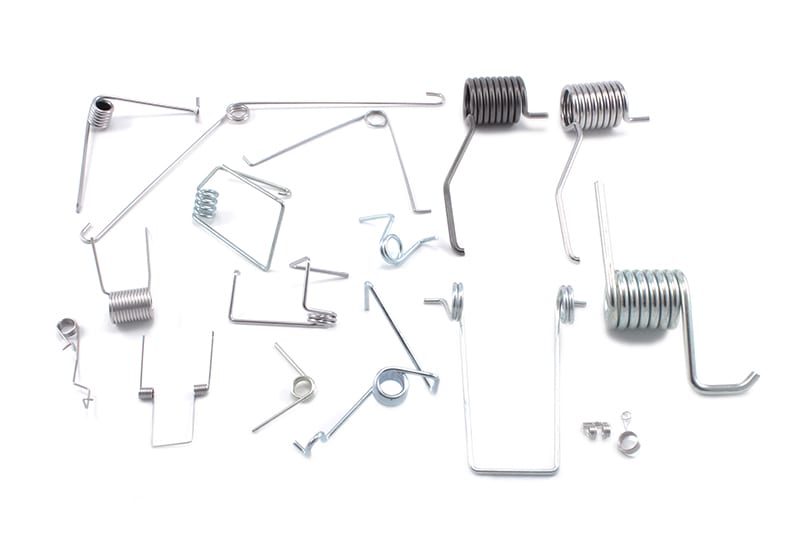
 Spiral torsion springs are mechanical devices that store and release mechanical energy through the exertion of rotational torque force. It is one of two basic torsion spring designs, the other being the more familiar helical or coiled torsion spring, the shape of which resembles the compression or extension spring, and operates in a radial direction in applying torque.
Spiral torsion springs get their name from the concentric spirals in which they are wound. Manufactured from flat types of steel, they are engineered to operate in confined spaces and must provide a large amount of torque in a very short rotation. The short rotation is due to the torque curve being linear to the degree of rotation. This design feature allows spiral torsion springs to store more mechanical energy than helically designed springs, such as compression or extension springs.
Popular Applications
Because of their operational requirements, spiral torsion springs are typically used as components for various motion controls in automatic devices and machinery that require a short rotation, such as electric motor contact brushes. They are also found in clocks, kitchen timers, and toys. They are used in watches, galvanometers, and in steering wheels or other places where electricity must be carried to partially rotating devices without hindering the rotation.
Spiral torsion springs are ideally suited for applications that exert rotational torque of fewer than 360 degrees of angular rotation. They are wound in the flat state in concentric spirals that rotate in a circular movement. The spirals are aligned symmetrically between the coils and must not make contact with each other during operation. The symmetrical spacing is maintained for the springs to function properly. Any greater deflection would cause the coils to make contact with each other and result in a spike in torque and stress, and cause the coils to close out. The inner end of the spring—the inner ring of the concentric circle—is typically bent to attach to a hub, referred to as an arbor. The outer end of the spring is attached to the rotating object which utilizes the torque of the spring. Once they are configured, a spiral torsion spring can perform large angular deflections of many revolutions, with relatively little variation in torque during the movement.
Custom Design of Spiral Torsion Springs
Considerations when manufacturing custom design of spiral torsion springs include diameter, materials, and number of concentric coils. Material is a key consideration and using the right material is vital for the application to function as designed. In order to make certain that a higher torque is generated over shorter degrees of rotation, spiral torsion springs are typically made with heavier steel material—carbon steel, spring steel, annealed spring steel, stainless steel or specialty alloys—which must be coiled into a flat spiral. Once the spring is properly formed, the spiral springs are then heat-treated to ensure proper spring function. Depending on the application requirements, the material may be finished with a corrosion-resistant lubricant or powder coating.
Because springs are designed to carry out an array of diverse functions, there is a diverse array of differences that exist between each spring design. Spiral torsion springs are unlike other spring designs in the way they store and release mechanical energy. More familiar compression springs and extension springs store and release their energy through a push or pull force. Torsion springs, in general, store and release mechanical energy via a torque or twisting force. As one of two basic torsion spring designs, spiral torsion springs are wound in concentric spirals. Engineered to function in confined spaces, spiral torsion springs are the most common flat spring and are widely used in applications and devices used in the aerospace, electrical, medical, and automotive industries, among others.
If you’re in the market for spiral torsion springs or need a custom spring manufactured, contact James Spring today!