

 When a spring takes a bounce, the bounce it takes is a result of the spring’s deflection. Spring deflection is the action or motion that results from the application or release of a load. It is the response to a force when it is applied or removed. Spring deflection is also known as spring travel, which is a reference to the distance a spring moves between the loaded and the preloaded position. Spring travel, i.e., the traveled distance when a spring compresses, extends or twists, is its deflection.
Understanding spring deflection is essential in the design and manufacture of all springs. Deflection occurs whenever a spring is loaded, whether compressed, extended or radially turned. The calculus to estimate the spring deflection required for applications is derived from Hooke’s Law, a principle of physics named for the 17th-century British physicist Robert Hooke, who sought to understand the relationship between the laws of elasticity, torsion, and the forces that come into play when a spring is compressed or extended.
Hooke’s Law
The formula for Hooke’s Law is expressed as Fs = kx, where F is the force of the spring, which is equal to k, the spring constant—that force needed to stretch or press a spring, divided by the distance that the spring gets longer or shorter—and x is the displacement of the spring. Spring deflection for the desired application would be calculated by dividing the spring’s force (Fs) by the constant of the spring (k) to measure its displacement (x). Hooke’s Law determined the force needed to extend or compress a spring by some distance is proportional to that distance.
Calculus aside, spring deflection for any application is required to determine the maximum load a spring can carry as it accounts for the stress a spring must endure. The rate of the spring’s deflection is another calculation in the design of custom spring applications as well as for those manufactured for general applications. For instance, engineers requiring a deflection rate of 200 lbs. per inch for a compression spring would need the spring to compress one inch for every 200 pounds of load applied to it. The formula for calculating the deflection rate is D = L/R, i.e., the load (L) divided by rate (R) = deflection (D). Thus, the spring’s rate of deflection will determine the amount of spring deflection that will occur.
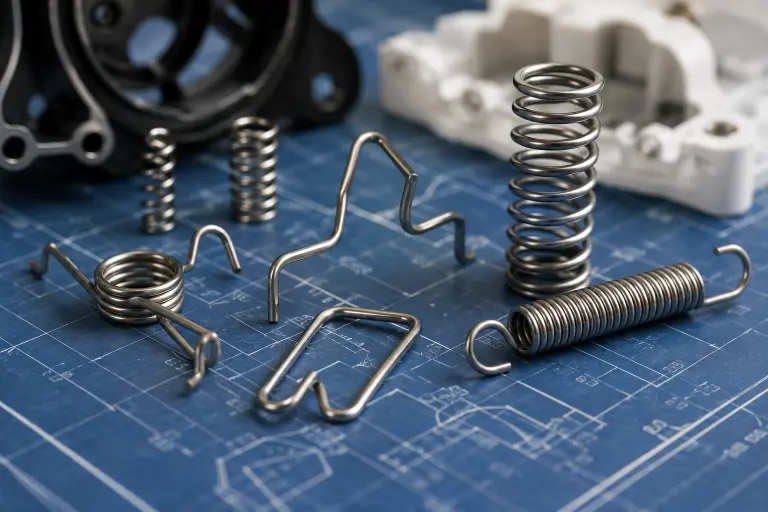
Different types of springs may have different spring deflection qualities. The action of a compression spring as it is compressed (pushed), an extension spring as it is extended (pulled), or a torsion spring as it is torqued (twisted) when a load is applied or released have different spring deflection qualities.
Deflection Rate
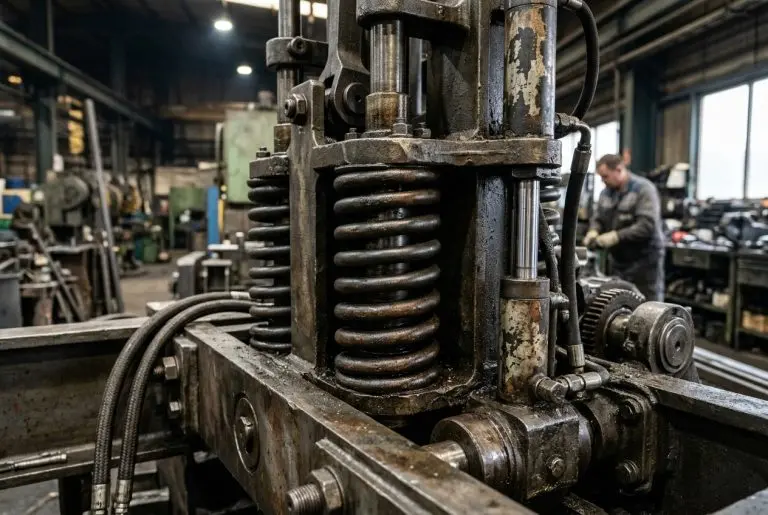
The deflection rate for regular compression springs is linear, meaning that the weight deflects evenly across the spring as it is being pushed. In a set position, compression springs have a zero load at zero deflection. However, differently shaped compression springs like conical shaped springs can have variable deflection rates. The force required for deflection occurs at different positions in the spring as it is being compressed. For applications requiring compression springs with conical or barrel shapes for example, be aware that the amount of force required for deflection is variable and can change.
Unlike compression springs, extension springs are wound with an initial load or tension. When set, extension springs can have a preload at zero deflection. The deflection rate then is calculated by the load required to initiate coil separation when the spring is pulled.
Torsion springs function on a radial axis, rather than through compression or extension when loaded or unloaded. Energy is stored and released in response to torque causing its spring deflection to be angular. When torque is applied, the twisting action reduces the coil diameter and increases body length. Potential energy is collected when wound and released when unwound. The spring deflection is angular due to the radial motion of the spring. The design of torsion springs must consider the effects of angular deflection of the torque.
Custom Spring Manufacturing
James Spring and Wire Company has successfully partnered with fabricators, engineers, and design firms alike in the design and manufacturing of custom springs. Our in-house engineering department can help you with your specific spring design to ensure that your design specifications are met and the best, quality spring is manufactured for your application. To learn more about how we can help you, contact James Spring and Wire today!