

Understanding Spring Rate
When designing or selecting a compression spring, one of the most critical performance factors to consider is the spring rate—also known as spring constant or k-value.
Spring rate defines how much force a spring exerts per unit of deflection. In simple terms, it’s the amount of load (in pounds or newtons) required to compress the spring by one inch or one millimeter. This value determines how the spring will behave under load and directly impacts performance, safety, and product lifespan.
The Formula for Calculating Spring Rate
The basic formula for determining the rate of a compression spring is:
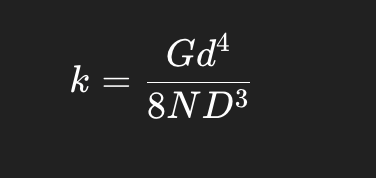
Where:
- k = spring rate (force per unit of deflection)
- G = modulus of rigidity (material stiffness)
- d = wire diameter
- N = number of active coils
- D = mean coil diameter (outer diameter – wire diameter)
This equation shows how even small changes in design parameters—such as wire thickness or coil count—can have a major effect on the final spring performance.
Breaking Down the Key Variables
1. Wire Diameter (d)
The wire diameter has the most significant influence on spring rate because it’s raised to the fourth power in the formula. A small increase in wire diameter results in a much stiffer spring.
2. Coil Diameter (D)
The mean coil diameter affects the rate inversely. A larger coil diameter will produce a softer spring, while a smaller diameter increases stiffness.
3. Number of Active Coils (N)
Fewer coils mean less deflection and a higher spring rate. Increasing the number of active coils allows more deflection and lowers the spring rate.
4. Material Type and Modulus of Rigidity (G)
Different materials have unique stiffness characteristics. For instance:
- Stainless Steel (Type 302/304): Excellent corrosion resistance, moderate stiffness
- Music Wire (ASTM A228): High tensile strength, consistent performance
- Phosphor Bronze & Beryllium Copper: Better conductivity and fatigue resistance
Choosing the correct material ensures both performance and longevity in your application.
Example Calculation
Let’s consider a basic example:
A spring made of music wire (G = 11.5 × 10⁶ psi) has the following characteristics:
- Wire diameter (d) = 0.08 in
- Mean coil diameter (D) = 0.5 in
- Active coils (N) = 8
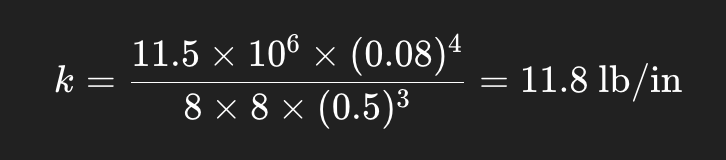
That means this spring requires 11.8 pounds of force to compress it by one inch.
Design Considerations and Practical Adjustments
When designing a compression spring, engineers must consider more than the calculated rate. Factors such as solid height, free length, working load range, and fatigue life also influence real-world performance.
Manufacturing tolerances, end types (closed, ground, open), and surface finishes (e.g., shot peening, electro-polish, or passivation) can all affect how the spring performs under stress and over time.
James Spring & Wire’s engineering team helps customers fine-tune these variables to achieve the desired performance and efficiency—whether for high-speed mechanical assemblies or precision instrumentation.
Why Partner with James Spring for Compression Springs
James Spring & Wire Company brings decades of experience in spring design, material selection, and manufacturing precision. The company’s in-house team works directly with engineers and procurement professionals to optimize every parameter—from wire selection and coiling process to post-treatment and testing.
This expertise ensures that each compression spring is built for consistent performance, reliability, and cost efficiency—whether you need prototype quantities or large production runs.
Learn more about Compression Springs at James Spring & Wire Company.
The Takeaway
Knowing how to calculate and interpret spring rate is essential to ensuring that your compression spring performs as intended. With expert engineering support and precision manufacturing, James Spring helps customers turn calculations into real-world solutions—bridging the gap between design theory and practical application.