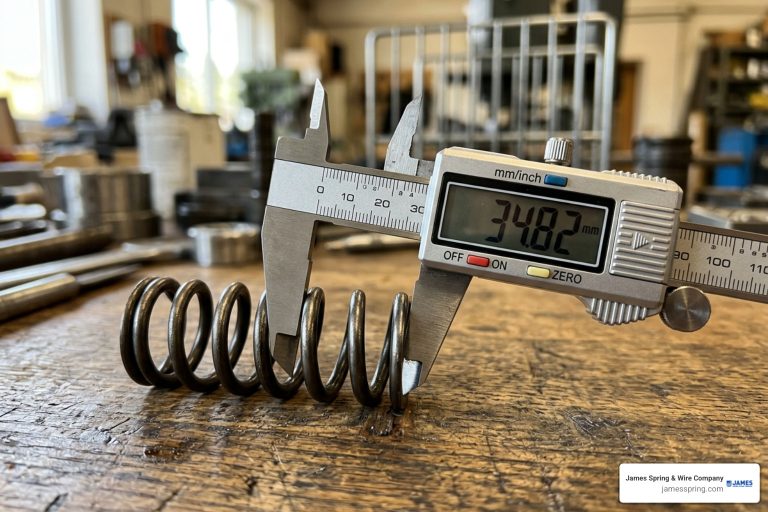

Types of spring materials used in spring fabrication vary depending on the design and application requirements. Principally, these materials consist of spring steels, a group of medium-to-high carbon, low alloy steels characterized by their excellent yield strength—an important material property that allows a spring to bend, twist, compress or extend and return to its original shape without deforming. In other words, yield strength is the maximum amount of stress a material can handle before it starts to permanently deform, which is an essential characteristic of every type of spring.
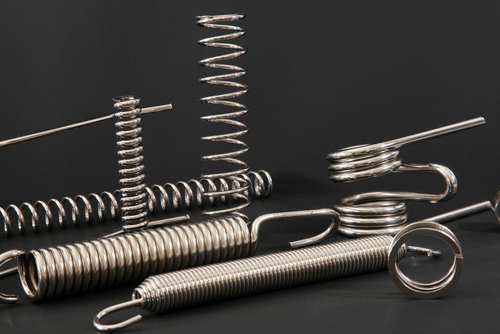 Spring fabrication is a precision manufacturing process, and the choice of materials, heat treatment, and fabrication methods can significantly impact a spring’s performance. Three main types of metal alloys used in spring fabrication—music wire, stainless steel, chrome silicon, or simply chrome—are regarded for their yield strength among other material properties. Here’s why:
Music Wire
Also known as piano wire, music wire is actually a type of high-carbon steel wire that is commonly used for spring fabrication due to specific properties and characteristics that make it well-suited for many spring applications. Well-regarded for a number of material properties, music wire offers high tensile strength, with a high elastic limit that allows it to withstand a significant amount of stretching or pulling force without deforming or breaking. Music wire offers ductility and high fatigue resistance. The material can be bent and shaped into various spring designs without snapping and, during its service life, can endure hundreds of thousands of repeated cycles of compression and expansion without significant degradation in performance. Music wire is often coated with a thin layer of zinc or other corrosion-resistant materials to protect it from rust and environmental factors. This helps ensure the longevity of the springs, especially in applications exposed to moisture or harsh conditions.
Spring components made of music wire are used in a variety of industrial and commercial applications, ranging from antennas, fishing lures, cheese slicers, and surgical instruments to machinery, radio-controlled aircraft engines, small aircraft landing gears, and, of course, musical instruments. Though music wire offers many advantages for use in numerous applications, it is vulnerable to extreme temperatures and can give under-stock loads. It also tends to lose its high tensile strength when the wire’s diameter is increased.
Stainless Steel
Stainless steel is well-known for its excellent corrosion resistance thanks to a chromium content of at least 10.5%. Its corrosion-resistant properties make it an ideal material for applications in which the spring may be exposed to moisture, chemicals, or harsh environmental conditions. It is a durable material, too, that can withstand a wide range of temperatures and environmental factors without losing its mechanical properties. Stainless steel has good tensile strength and can be hardened to achieve even higher strength levels. This makes it suitable for applications where a spring needs to provide significant force or support heavy loads. Stainless steel has good resistance to fatigue, as well, which is essential for springs that undergo repeated cycles of compression and extension.
Springs made of austenitic stainless steel have non-magnetic properties for use in sensitive applications such as electronic equipment or medical devices. As a nonporous material, stainless steel is easy to clean and sterilize, making it suitable for applications in industries like food processing, medical and healthcare, and pharmaceuticals, where cleanliness and hygiene are critical. Its shiny, attractive appearance gives it an aesthetic appeal for use in decorative spring applications.
While stainless steel has many advantages, it’s worth noting that it can be more expensive than other spring materials, and the choice of stainless steel alloy should be carefully considered based on the specific requirements of the application. Different stainless steel alloys have varying properties, so the selection should be made to match the desired performance characteristics.
Chrome Springs
Chrome springs, like most springs, are typically made from various types of spring steel with the addition of “chrome silicon” or “chrome vanadium.” These materials are alloyed steels that provide mechanical properties like high tensile strength and elasticity but also offer exceptional corrosion resistance and durability.
Chrome silicon is a type of spring steel known for its durability and resistance to fatigue, which makes it suitable for spring applications that undergo repetitive loading and unloading cycles. Its high tensile strength and unmatched resilience make it a choice material for high-temperature applications or use for heavy-shock loads. Spring components made from chrome silicon are often found in automobiles, aircraft, and for general industrial applications.
Chrome vanadium is noted for its good to excellent fatigue properties, high strength, toughness, and resistance to wear, making it well-suited for high stresses, shock loads and moderately elevated temperature applications. It is used in applications like steel hand tools, large-diameter spring wires, and other high-stress applications.
Spring manufacturers can tailor the material and heat treatment to achieve the desired spring properties. The use of chromium or chromium alloys in spring fabrication can provide various advantages in terms of durability and corrosion resistance, but the choice of material and the specific composition should be carefully considered in the context of the specific application’s needs.
James Spring & Wire Company manufactures many types of springs for a wide range of industrial applications. Our facility features the latest wire and spring manufacturing technology, and the most advanced equipment. We are happy to assist you in selecting the material best suited to meet your spring application requirements. For more information, please contact us with any questions or to discuss our capabilities.