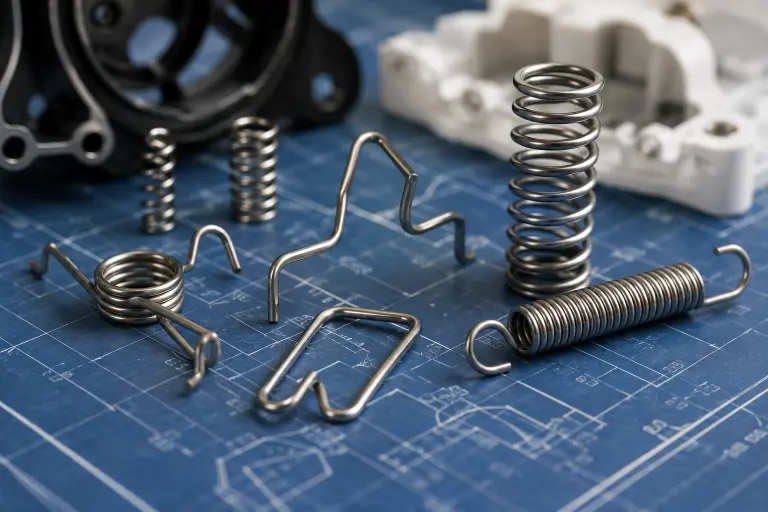



Custom wire forms are used extensively in a diverse range of industries and have the potential for endless possible uses. Simply put, a wire form is a part that is fabricated out of flat or round wires into the desired form (or bend) to create a finished product with the necessary angles and length for the application. The customization of wire forms is the exact reason they are so versatile. They are also available in an array of shapes and sizes, a variety of materials, and manufactured using advanced CNC machines.
Custom Wire Forms for the Lighting Industry
One industrial sector that uses custom wire form springs consistently is the lighting industry. Lighting manufacturing requires intelligently designed precision made wire form spring options in order to best suit the functionality and volume required for the demand of the industry. With the help of CNC machinery and several other advanced techniques, today’s leading manufacturers deliver accurate wire forms for even the most intricate assembly operations. By using 0.015”-0.250” diameter range wire, they can produce custom wire forms of desired angles, straightness, or curvature needed. At James Spring & Wire, we are experienced in working with Aluminum, Basic Wire, Beryllium Copper, Brass, Bronze, Chrome Silicon, Chrome Vanadium, Copper, Elgiloy, Hard Drawn Wire, Hastelloy, Inconel, Monel, MP35N, Music Wire, Nitinol, Oil Tempered, Phosphor Bronze, Stainless Steel (17-7 SS, 302 SS, 304 SS, 316 SS, & 316L SS), and Titanium. These materials are used to produce the wire form spring with various surface treatment options including:
- Plating
- Anodizing
- Bead Blasting
- Citric & Nitric Passivation
- Cleaning – Conventional and Ultrasonic
- Color Coding
- Deburr – Vibratory & Tumble
- Electro Polish
- Laser Etching
- Powder Coating
- Rust Preventative
- Shot Peening
- Stress Relieving & Heat Treating
Why are Custom Wire Forms So Popular in the Lighting Industry?
There are many reasons customers turn to custom wire forms for lighting products but the reason is largely due to the following benefits:
- They can also increase a product’s operating efficiency.
- They reduce product weight.
- They minimize tooling cost.
- Wire forming is a quicker process than hand or air-bending.
- The manufacturing stage involves fully machining processes such as CNC machining, milling and turning, grinding, stamping, sheet metal, extrusion, casting, and assembly. This ensures the making of precision and tight tolerance wire forms.
- Wire forms are available in a range of materials from standard stainless steel to exotic materials.
- Available in various plating finishes upon request including Black Oxide, Cadmium Chrome, Gold, Nickel, Phosphate, Tin, and Zinc.
When you require custom wire forms for lighting, James Spring & Wire Company offers precision wire forms in a range of materials, including exotic materials, copper, and stainless steel that can be manufactured to specific angle and length requirements. When working with a reliable leading manufacturer in the market, you will obtain reliable wire forms manufactured in compliance with international quality standards and regulations. Request a quote today to get started.
Photo: InnovationTrail