
Stainless steel offers superior corrosion resistance, long-term durability, and stable performance in outdoor or moisture-exposed environments, making it ideal for springs, wire forms, and clips used in HVAC, consumer products, and outdoor equipment. High-carbon steel delivers higher strength and lower cost but requires coatings and can degrade faster outdoors without proper protection.
Why Material Selection Matters in Outdoor Components
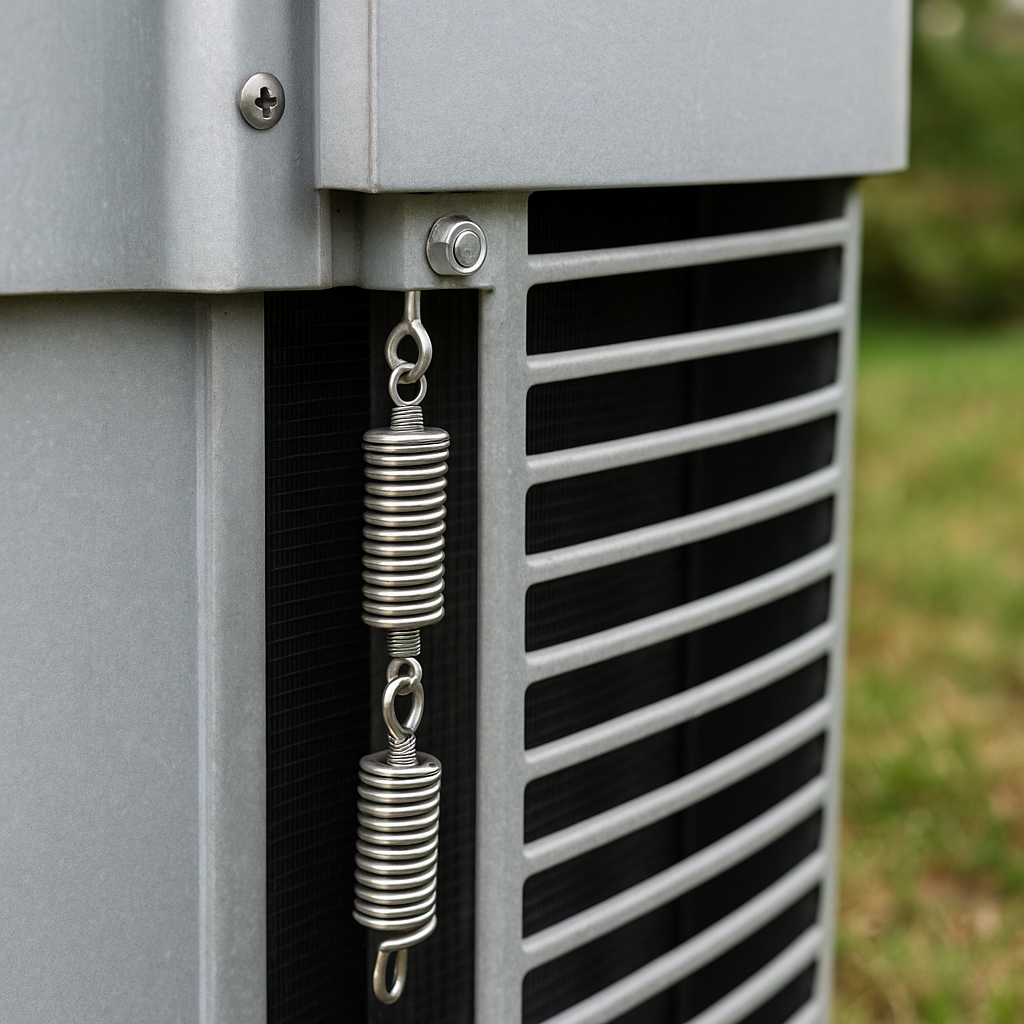 For OEM manufacturers, material choice directly impacts product lifespan, performance accuracy, maintenance requirements, and total cost of ownership. Outdoor environments introduce challenges such as:
- Moisture and humidity exposure
- Salt, chemicals, or industrial pollutants
- UV and temperature cycling
- Load, fatigue, and vibration stresses
Springs, wire forms, and HVAC-style clips in these conditions must maintain load consistency, avoid corrosion-driven failures, and support long maintenance intervals. Stainless and high-carbon steel are the two most common choices — but they behave very differently outdoors.
Stainless Steel for Outdoor Use
Stainless steel is the preferred material for outdoor spring and wire form applications because of its excellent corrosion resistance and stable mechanical performance.
Key Benefits
- High corrosion resistance in moisture, salt spray, chemicals, and temperature swings.
- Long service life with minimal maintenance.
- Good fatigue resistance for repeated cycling.
- Non-rusting appearance—important for consumer and medical products.
- Consistent performance across varying climates.
Ideal Outdoor Applications
- HVAC equipment & air-handling components
- Outdoor consumer goods
- Medical carts and portable devices
- Marine and coastal products
- Agricultural machinery
- Outdoor power equipment
- Filtration clips & fasteners
- Assemblies exposed to washdowns or condensation
Most Common Stainless Spring Grades
- 302/304 Stainless – Balanced strength, excellent corrosion resistance.
- 316 Stainless – Marine-grade, chloride-resistant; ideal for coastal and chemical environments.
- 17-7 PH Stainless – High strength, better heat resistance; great for demanding mechanical loads.
High-Carbon Steel for Outdoor Use
High-carbon steel offers excellent strength and cost efficiency, but outdoor environments expose its vulnerabilities.
Key Strengths
- Higher initial tensile strength than many stainless grades.
- Excellent elasticity and load capacity.
- Cost-effective for large-volume OEM applications.
- Predictable forming and manufacturing behavior.
Limitations in Outdoor Environments
- Poor corrosion resistance without coatings.
- Susceptible to rust, pitting, and fatigue degradation.
- Shorter service life if exposed directly to moisture or outdoor conditions.
- Requires secondary treatments such as zinc plating, black oxide, powder coating, or painting.
High-Carbon Steel Works Best For
- Controlled or dry environments
- Internal mechanical assemblies
- High-load components not exposed to moisture
- Cost-sensitive high-volume production
- Applications where coatings can be maintained
Direct Comparison: Stainless vs. High-Carbon Steel Outdoors
| Property | Stainless Steel | High-Carbon Steel |
|---|---|---|
| Corrosion Resistance | Excellent | Poor without coatings |
| Outdoor Durability | High | Low–Moderate |
| Tensile Strength | Moderate–High | High |
| Fatigue Life | Strong | Strong (but reduced outdoors) |
| Maintenance | Low | High |
| Cost | Higher upfront | Lower upfront |
| Best Use Cases | Outdoor, medical, HVAC, marine | Indoor, high-load, cost-driven |
Bottom Line:
If the component will face outdoor exposure — stainless steel is the more reliable, longer-lasting choice. High-carbon steel is viable outdoors only when protected with coatings and when maintenance can be ensured.
How OEM Engineers Should Choose the Right Material
Material selection should align with both functional requirements and environmental exposure. Consider:
✔ Corrosion Risk
Outdoor environments, especially coastal or industrial areas, demand stainless steel.
If carbon steel must be used, plan for coatings and inspection cycles.
✔ Load and Deflection Requirements
High-carbon steel may offer cost advantages for high-load components with minimal exposure.
For outdoor springs that cycle frequently, 302/304 or 17-7 stainless offer more reliable fatigue performance.
✔ Regulatory & Industry Standards
Medical, aerospace, and HVAC products often require stainless due to hygiene, longevity, and environmental conditions.
✔ Manufacturing Constraints
Some complex wire forms or torsion springs may benefit from the forming predictability of high-carbon steel—if paired with protective finishing.
✔ Lifecycle Cost
Stainless steel reduces maintenance, field failure rates, warranty claims, and replacement frequency — often delivering lower total cost of ownership.
Real-World Use Cases Across Industries
HVAC Manufacturing
Stainless steel clips, torsion springs, and wire forms withstand condensation, air impurities, and seasonal moisture — crucial for air filtration reliability.
High-carbon steel is used when components remain dry or protected within assemblies.
Consumer Products & Outdoor Equipment
Outdoor locks, latches, handles, and tool assemblies benefit from stainless steel’s corrosion resistance and aesthetic stability.
Defense & Aerospace
Stainless steel provides dimensional stability across temperature extremes and ensures long-term performance in field environments.
Medical & Laboratory Equipment
Stainless steel prevents corrosion near sterilization agents, disinfectants, and moisture, while maintaining consistent mechanical properties.
When Coated High-Carbon Steel Is the Right Choice
There are situations where high-carbon steel is both cost-effective and technically appropriate outdoors, such as:
- Components with temporary or limited exposure
- Parts are protected inside sealed housings
- Applications where coatings (zinc, phosphate, epoxy, polymer) can be reliably maintained
- High-volume OEM programs where material cost materially impacts BOM pricing
James Spring engineers can recommend coating systems that extend carbon steel’s outdoor lifespan.
Work With a Manufacturer That Understands Outdoor Performance
Material choice isn’t simply a cost decision — it’s a functional engineering choice. OEMs rely on James Spring & Wire to evaluate:
- Load and deflection requirements
- Required corrosion resistance
- Fatigue life
- Manufacturability
- Expected environmental exposure
- Material availability and lifecycle cost
With capabilities in compression, extension, torsion springs, wire forms, strip forms, andHVAC clips, James Spring supports prototypes through full-scale production for demanding outdoor environments.
FAQ: Outdoor Spring & Wire Form Materials
1. What is the best material for outdoor springs?
Stainless steel is typically the best option due to corrosion resistance, stability in temperature changes, and long-term durability.
2. Can high-carbon steel be used outdoors?
Yes, but only with proper coatings. Uncoated carbon steel rusts quickly in moist environments and may not meet long-term performance requirements.
3. Does stainless steel have enough strength compared to carbon steel?
Yes. While carbon steel often has higher initial strength, stainless steel provides more reliable performance outdoors, especially in cycling applications.
4. What stainless steel grade is best for coastal or high-moisture areas?
316 stainless steel offers the highest resistance to chlorides, salt, and aggressive outdoor environments.
5. How do I choose the right material for my application?
Consider corrosion exposure, load requirements, cycle life, environmental conditions, and lifecycle cost. James Spring’s engineering team can evaluate these factors and recommend the optimal material.
Need reliable, application-specific guidance for outdoor spring or wire form performance
James Spring & Wire engineers can help you select the right material, finalize design tolerances, and ensure manufacturability for your OEM application.
Request a Quote or talk to an engineer today and get manufacturing-ready support built around your performance requirements.
